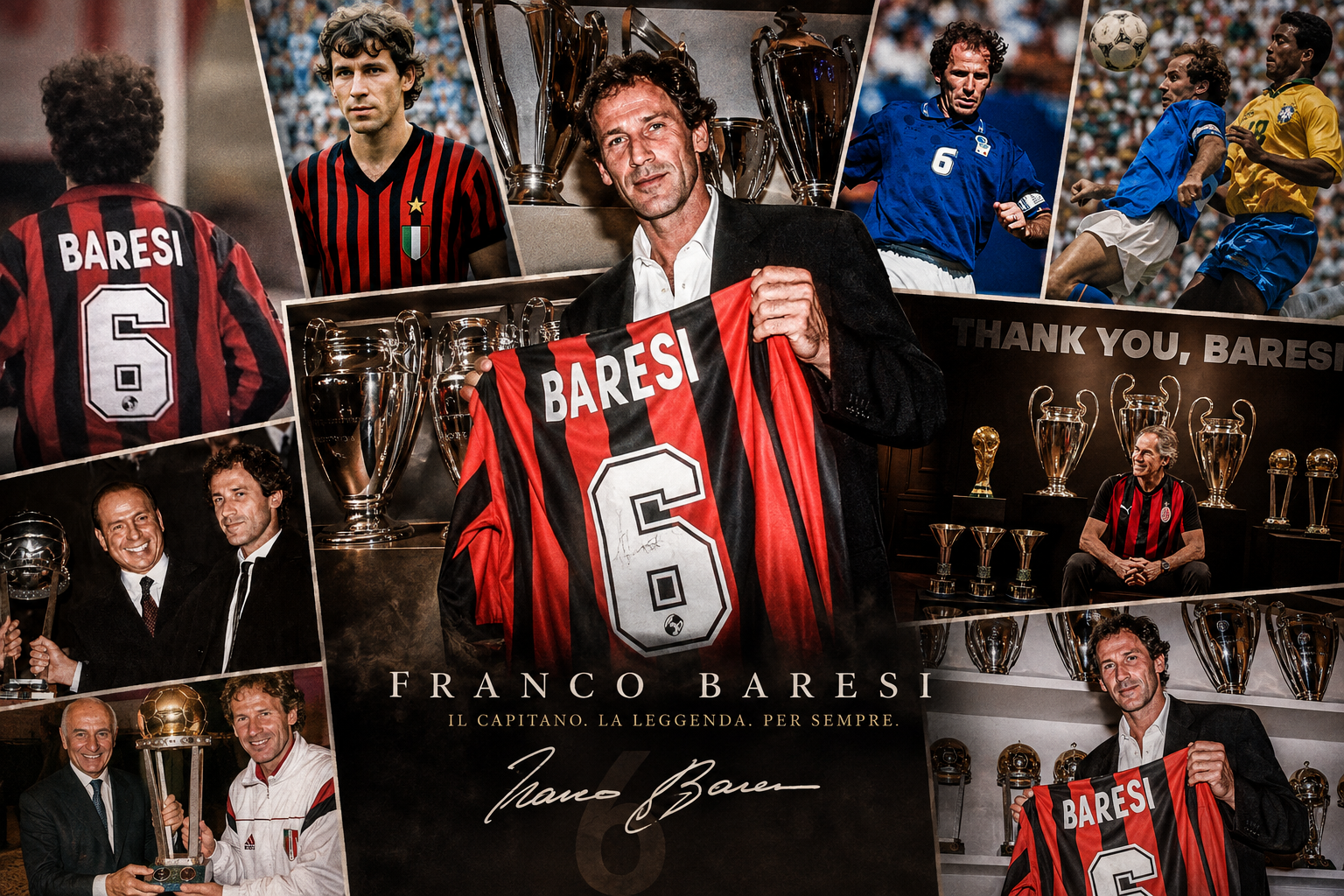
For 20 years, Baresi was the backbone of AC Milan and Italy. In a sport where loyalty is often traded for accolades or riches, how did a 5 ft 9 defender become the impenetrable wall against monsters?
Defending has long been the dark art of football, a craft that turns men into giants and attackers into shadows. Yet among the masters, one rose above them all, Franco Baresi. Standing just 5ft 9, he became an unbreakable wall, not through brute strength, but through tactical genius and a grace that transformed defense into poetry. His presence was elegance wrapped in steel, a sight that made even the fiercest strikers tremble.
This is the story of how a 5ft 9 Italian became the impenetrable wall not through brute force but tactical supremacy and an elegance never seen before in football.
Let them doubt you, betray you, overlook you, and count you out. Time has a way of exposing who was built to last and when the noise dies, the weak disappear, the crowd moves on, but the 6 never dies. – Anonymous
Great defenders are often defined by physical force, the thunderous tackle, the imposing aerial duel, or the intimidation of raw power. Franco Baresi redefined the craft entirely. Standing at just 5 feet 9 inches, he stood taller than giants not through brute strength, but through total tactical supremacy, unmatched anticipation, and a stoic elegance that elevated defending to a fine art.
For two decades, Baresi was the beating heart of AC Milan and the backbone of the Italian national team. In a sport where loyalty is often traded for accolades or riches, Baresi’s bond with the Rossoneri remained unbreakable, a true single-club icon who wore his heart, and his iconic shirt, on his sleeve.
The Birth and Genesis of a Leader: Loyalty in the Darkest Hours
Born in Travagliato in May 1960, Baresi’s journey began with a moment of quiet irony. As a boy, he was rejected by Inter Milan who instead signed his older brother, Beppe. AC Milan saw what their cross-town rivals missed, welcoming the teenage defender into their academy in 1974. Making his senior debut in April 1978 just before turning 18, Baresi quickly established himself as a natural prodigy in the backline.
His true character, however, was forged in adversity. In the early 1980s, AC Milan endured one of the darkest chapters in its history, suffering two painful relegations to Serie B. While established stars fled San Siro to protect their status and earnings, the young Baresi refused to abandon the ship.
Handed the captain’s armband in 1982 at just 22 years old, Baresi shouldered the responsibility of dragging a historic club back from the abyss. He navigated the mud and grit of the second division with the same grace he would later display on European football’s grandest stages. By standing firm when it was easiest to leave, Baresi became more than just a talented defender; he became the soul of AC Milan.
Master of the Libero: The Sacchi and Capello Revolutions
When charismatic media mogul and billionaire Silvio Berlusconi acquired AC Milan in 1986 and appointed Arrigo Sacchi as manager, modern football was born, and Baresi was its supreme architect on the pitch.
Sacchi’s tactical vision demanded a high defensive line, suffocating pressing, and synchronicity among the back four. Baresi was positioned as the libero, the free man, or sweeper. While traditional sweepers sat deep behind the main line, Baresi transformed the role. He stepped up into midfield, intercepted passes before danger could materialize, and orchestrated the offside trap with mathematical precision. With a single raised arm, Baresi would align his defensive partners in perfect unison.
Together with Mauro Tassotti, Alessandro Costacurta, and a young Paolo Maldini, Baresi marshaled what is universally acknowledged as the greatest backline in the history of club football with feats never before seen in the game.
The numbers don’t lie and Baresi’s brilliance told a tale of utter dominance:
1. In the 1987–88 Serie A season, Milan conceded only 14 goals in 30 league matches.
2. Under Fabio Capello, who succeeded Sacchi, Baresi captained Milan through an astounding 58-match unbeaten run in Serie A, a record that stands as an untouchable monument to defensive stability.
3. Across 719 competitive appearances for AC Milan, Baresi lifted six Serie A titles, three UEFA Champions League trophies, two Intercontinental Cups, and four Supercoppa Italiana titles.
4. In 1989, Baresi finished as the runner-up for the Ballon d'Or behind his teammate Marco van Basten, a rare feat for a central defender that highlighted his peerless standing in global football.
Staggering as these numbers were at the time, one match singled out the warrior and peerless quality of Franco Il Capitano in 1994 under the scorching sun in Pasadena, California which was the 1994 World Cup final hosted by the United States
25 Days to Immortality
Already a World Cup winner as part of Italy’s 1982 squad in Spain, Baresi had arrived at the 1994 tournament as Italy’s captain and undisputed leader. Disaster struck during the group stage against Norway when he tore his knee meniscus and standard medical consensus at the time ruled that his tournament was over.
Instead, Baresi, a fighter per excellence and one who had been forged through the darkest hours, underwent surgery in the United States and embarked on a grueling, round-the-clock rehabilitation program. Exactly 25 days after knee surgery, Baresi shockingly strode onto the turf of the Rose Bowl to start the World Cup Final against Brazil’s formidable attacking pair of Romário and Bebeto.
What followed was perhaps the greatest individual defensive performance ever recorded in World Cup history. For 120 grueling minutes in suffocating heat, playing through physical agony, Baresi matched every run, won every tackle, and cut out every threat, holding Brazil goalless. Though Italy ultimately fell in the cruelest manner via a penalty shootout that left Baggio still, Baresi’s heroic display cemented his legacy as an ultimate warrior.
When Franco Baresi retired at the end of the 1996–97 season aged 37, AC Milan made an unprecedented decision: they permanently retired the number 6 shirt. It was the first time in Italian football history that a club took a number off the pitch forever in honor of a player, ensuring no one else would ever wear the number six for the Rossoneri.
Opponents revered him not only for his skill, but for his profound dignity. Diego Maradona once remarked that Baresi was one of the toughest, most honorable competitors he ever faced. Paolo Maldini, who inherited the captaincy and learned his craft alongside Baresi, repeatedly called him his ultimate mentor and the standard for leadership.
Baresi taught the world that defending was not merely stopping the opponent; it was about reading the game seconds before anyone else, taking command through quiet authority, and remaining steadfast in the harshest of times when others falter.
Franco wore the 6.
Played with the number 6.
And died at the age of 66.
A true warrior and an eternal rest to the greatest defender ever.
Forza Milan
Il Capitano Definitivo.
Comments
Join the conversation
Pick your avatar
We'll email you only if someone replies. Your address is never shown.
Loading comments…