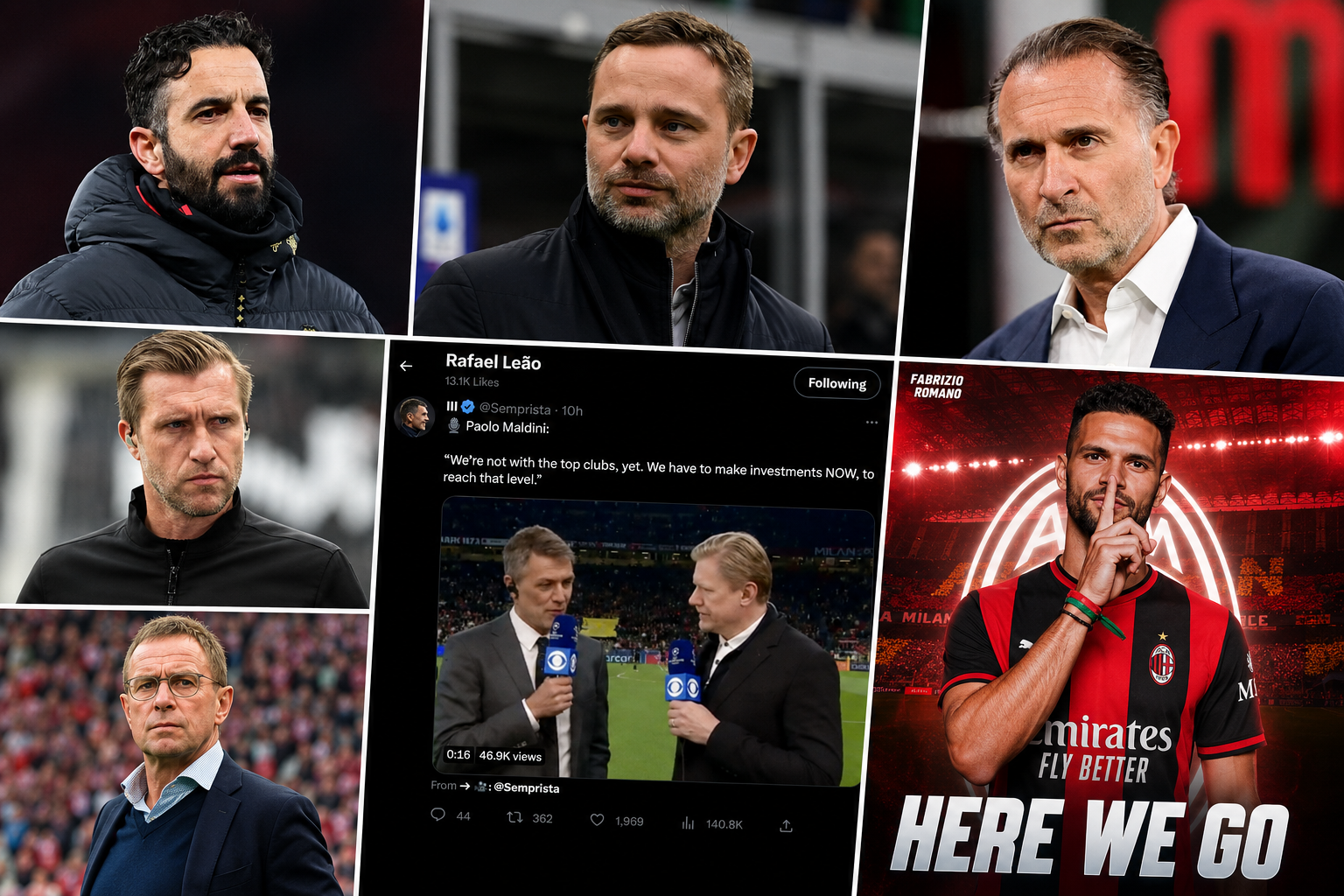
After a disastrous finish to the season, AC Milan descended into another round of boardroom warfare. Heads rolled, alliances shifted, and amid the chaos emerged a Portuguese coach no stranger to dysfunction. Will the Rossoneri finally embrace a clear footballing vision, or remain trapped in the power struggles that have turned the Redbird era into a circus?
Being an AC Milan fan has felt more like binge-watching a corporate reality show than following one of football's greatest institutions over the past two years. Every year brings a new twist: a coach hired, a coach dismissed, a sporting director linked, a sporting director rejected, a CEO asserting authority, and an owner accused of micromanagement, with transfer strategies shifting like the wind.
Outsiders dubbed it "the Cardinale Circus," and they weren't entirely wrong. Yet, history often punishes disunited organizations with repeated failure, and perhaps this is one such moment. To understand the full picture, we need to look back to 2023 where the problem began.
Gerry Cardinale: Villain or Casual Disruptor?
When Gerry Cardinale arrived, Milan fans dreamed of ownership that could restore the club to European dominance. Instead, many watched in disbelief as internal power struggles played out publicly. Supporters questioned every decision: Why was there no unified sporting vision? Why did executives seem to compete rather than collaborate? Why did every major football decision turn into a boardroom battle?
Critics argued that Milan had become too corporate and not focused enough on football. Cardinale inherited a club that had won a Scudetto but lacked the financial strength to consistently compete with Europe's elite.
The easy path would have been to preserve the status quo, but he chose to dismantle established structures, notably sacking legendary defender Paolo Maldini after a famous UCL semifinal interview where the legendary defender, now technical director, had called on the owner to reflect, start a new chapter, seize the moment, and follow a clear path to bring Milan back to its rightful place even if the process looked painfully messy.
Cardinale took the other way and had Maldini fired stating he would be starting on a new chapter different from the norm, demolishing the whole structure but sometimes demolition looks like competence until the new building finally rises and on shaky foundations, the house is doomed.
Enter Giorgio Furlani
Few figures have split opinion among Milan fans as sharply as Giorgio Furlani. To many, he embodied the creeping dominance of corporate interests in football, with every stalled negotiation pinned on him, every delayed transfer sarcastically dubbed a "Furlani masterclass," by his supporters and every bout of managerial instability seen as a reflection of his shortcomings. His focus was firmly on financial stability, and as a finance whiz, he enforced strict budget discipline, introducing a lean wage structure that prevented reckless contracts and trimmed bloated deals at the source.
Yet frustration brewed among supporters who craved clarity and decisive leadership. Instead, under Furlani, the club lurched from one questionable move to another—signings that failed to deliver (like Morata and Gimenez), puzzling acquisitions (such as Emerson Royale), and a revolving door of seemingly random names that offered little direction.
The backlash from Milan fans was inevitable, plunging the club into its most turbulent period since 2019. Yet Giorgio Furlani had one final move: abandoning risky gambles in favor of seasoned appointments, most notably the return of former Milan coach Massimiliano Allegri.
By 2025, Milan's ambitions stretched beyond mere stability, they sought evolution in a footballing landscape that increasingly rewarded proactive systems over reactive management. Allegri, long regarded as a rigid problem-solver, was paired with sporting director Igli Tare. But timing can be cruel; even as early results impressed, deeper flaws emerged.
The management's frugal, patchwork approach only papered over cracks, which eventually split wide open culminating in a final-day defeat to Cagliari and a devastating miss on Champions League qualification.
The fallout was explosive. Fans staged mass protests, some threatening extreme actions, while 30,000 supporters signed a petition demanding the dismissal of the entire leadership for incompetence. The sudden firing of Furlani, Tare, Geoffrey Moncada, and Allegri shocked many, not because criticism was absent, but because few expected such swift execution by Gerry himself. Yet as one saga closed, another was already beginning rekindling ties with a familiar figure from Milan's past.
Rangnick and Krösche
Nothing highlighted Milan's instability more than the revolving door of executives over the past four years. Ralf Rangnick, once seen as the visionary who could overhaul the football department, turned down the project, citing Zlatan Ibrahimović's overwhelming influence and Gerry Cardinale's refusal to grant him full authority. What began as a month-long saga shifted to new candidates, Eintracht Frankfurt's Markus Krösche and Timothy Hardung, only for talks to collapse, leaving Krösche in Germany.
Fans saw this as yet another rejection, another public embarrassment, but perhaps Milan gained something crucial: the realization that forced appointments without full alignment were doomed to fail. In a surprising pivot, the club finally committed to a unified vision of the sporting structure it truly needed by appointing former ATP director, Massimo Callvelli to lead Milan as its CEO working alongside Bobby Gardiner as Head of scouting team and Henrik Almstadt, who had worked with former Milan CEO Ivan Ghazidis.
Unlike past reactive hires, the appointment of Rúben Amorim carried a clear footballing philosophy. Reports suggested Milan chose him despite his failures at Manchester United as the man to usher in a new tactical era built on five defining principles.
1. Vertical football with structured pressing
2. Fluid positional rotations
3. Wing-backs providing width
4. Aggressive counter-pressing
5. Constant movement between the lines
Gonçalo Ramos: a statement of intent or an expensive gamble
The arrival of Rúben Amorim was quickly followed by a shock move that electrified Milan fans worldwide: the signing of Gonçalo Ramos from Paris Saint-Germain. In a whirlwind 48 hours, Milan splashed a record €74 million on the Portuguese striker, a two-time Champions League winner.
Reports framed Ramos as Amorim's top priority and the centerpiece of Milan's new project. On paper, the deal looked bold securing a classic poacher with relentless pressing ability. Yet skepticism lingered among sections of the fanbase, who questioned whether his output justified such a hefty fee, especially given his role as a backup at PSG.
If Ramos adapts swiftly, Milan's attack could achieve a cohesion unseen in recent years. But if the gamble fails, he risks joining the list of costly disappointments. Since Olivier Giroud broke the club's infamous No. 9 curse, Milan has already spent around €120 million on strikers (Morata, Abraham, Gimenez, and now Ramos) raising the stakes on whether this investment finally delivers lasting success or joins the list of underperforming frontmen.
The Cardinale era has looked chaotic, communication has often been poor and supporters have every right to question the constant upheaval and boardroom drama, but football history rarely rewards clubs that cling desperately to yesterday and sometimes genuine transformation looks exactly like confusion while it's happening.
Successful projects often appear dysfunctional before they become coherent and while that doesn't guarantee Milan will follow the same path.
The next twelve months will define Gerry Cardinale's ownership more than everything that came before. The excuses are gone, Furlani is in the past and the restructuring is looking to compete from day 1.
The football identity has also been chosen and a marquee striker has arrived, but now comes the difficult part which is winning by all means.
If Amorim's ideas translate positively in Serie A, Ramos becomes the attacking focal point Milan expect, and the board finally speaks with one voice instead of several, the Redbird circus may eventually be remembered as the painful birth of something far more sustainable.
Football rarely rewards perfection, it rewards conviction and for the first time in quite a while, AC Milan appear to have one.
Whether that conviction proves visionary or simply another chapter in the circus, it will be decided not in the boardroom but on the pitch with more than a million rossoneri cheering and chanting the team till the final whistle.
The Cardinale era has been marked by turbulence, poor communication, constant upheaval, and boardroom drama that left supporters questioning the project's direction. Yet football history shows that transformation often looks like chaos in real time. Many successful rebuilds appear dysfunctional before they eventually take shape, though there's no guarantee Milan will follow that path.
The next twelve months will be decisive for Gerry Cardinale's ownership as with Furlani gone and restructuring underway, excuses have run out. A football identity has been chosen, a marquee striker has arrived, and now the challenge is simple but unforgiving: win by any means necessary.
If Amorim's philosophy takes root in Serie A, Ramos becomes the attacking focal point Milan envisioned, and the board finally speaks with one voice, then what feels like a circus today may one day be remembered as the painful birth of a sustainable future.
Football doesn't reward perfection, it rewards conviction and for the first time in years, Milan seems to have found one.
Whether that conviction proves visionary or collapses into yet another chapter of chaos will be decided not in the boardroom but on the pitch, where over twenty million Rossoneri will continue to sing, chant, and drive their team forward until the final whistle.
Comments
Join the conversation
Pick your avatar
We'll email you only if someone replies. Your address is never shown.
Loading comments…